4-Pro-MET en calidad de laboratorio
Químico de investigación de grado analítico con pureza ≥99,5 % -- para fines analíticos y científicos.
C15H20N2O2, 274,364 g/mol – dat is 4-Pro-MET in de taal van de scheikunde. Systematisch heet het 4-Propionyloxy-N-methyl-N-ethyltryptamine (IUPAC: [3-[2-[ethyl(methyl)amino]ethyl]-1H-indol-4-yl] propanoate). Klinkt omslachtig. Maar het is logisch opgebouwd als je de drie bouwstenen van het molecuul begrijpt. Hier leer je hoe de indoolring werkt, waarom de propionyloxy-groep dienst doet als transportverpakking en wat 4-Pro-MET onderscheidt van verwante tryptamines. Geen voorkennis in organische scheikunde vereist.
Inhoudsopgave
- Laden...
De Tryptamine Kernstructuur
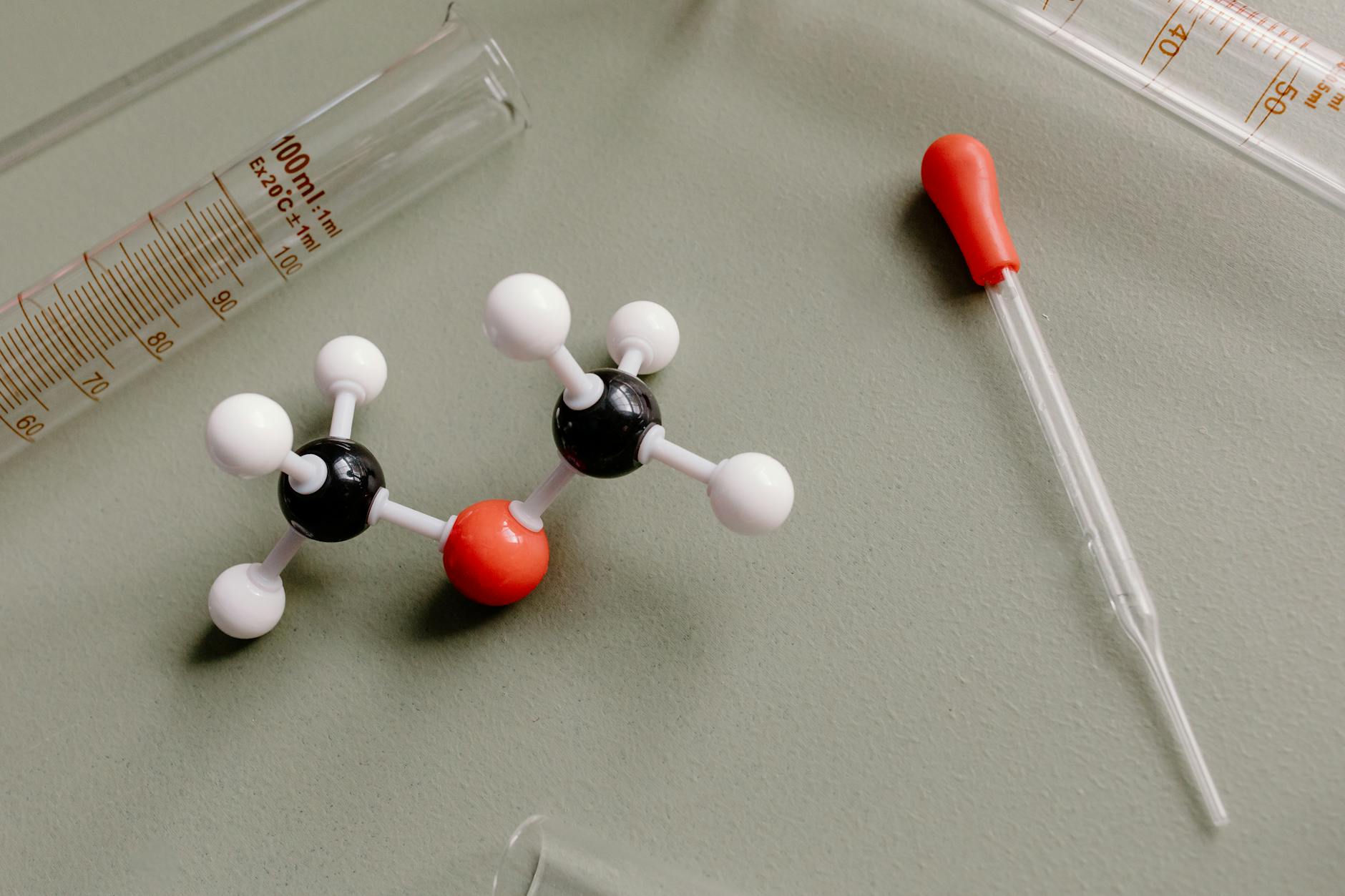
Serotonine, melatonine, psilocybine, 4-Pro-MET, 4-AcO-DMT – ze delen allemaal hetzelfde bouwplan: een indoolring met ethylaminezijaketen. De indoolring? Een benzolring (zes atomen), versmolten met een pyrrolring (vijf atomen). Op positie 3 van de pyrrolring hangt de ethylaminezijaketen – twee koolstofatomen met een stikstofatoom aan het einde. Dat serotonine (5-hydroxytryptamine, 5-HT) zelf een tryptamine is, toont hoe diep dit geraamte in de neurochemie verankerd is.
De SMILES-notatie van 4-Pro-MET: CCC(=O)OC1=CC=CC2=C1C(=CN2)CCN(C)CC – een compacte tekenreeks die de volledige 3D-structuur codeert. PubChem-CID: 169222171. Wat opvalt: tot april 2026 werd aan 4-Pro-MET geen CAS-nummer toegewezen. Voor een stof die in de chemische catalogus wil bestaan, is dat ongebruikelijk. Psilocybine ontving zijn CAS-nummer (520-52-5) in de jaren zestig, toen Albert Hofmann de stof voor het eerst isoleerde en synthetiseerde.
De drie bouwstenen van 4-Pro-MET
Drie delen, drie functies:
- De indoolring – het aromatische ruggengraat. Deze bicyclische ring past in de bindingsholte van de 5-HT2A-receptor als een sleutel in een slot. Zonder hem geen receptorbinding, geen serotonergeen psychedelicum.
- De ethylaminezijaketen met N-methyl-N-ethylsubstitutie – de vingerafdruk. Op het terminale stikstofatoom: een methylrest (CH3) en een ethylrest (C2H5). Deze asymmetrie onderscheidt 4-Pro-MET van psilocine/psilocybine (N,N-dimethyl) en beïnvloedt receptorselectiviteit en werkingsprofiel.
- De propionyloxy-groep op positie 4 – de transportverpakking. Een propionzuurester (-O-CO-CH₂-CH₃) aan de indoolring. In het lichaam splitsen esterasen deze groep af, waarbij een hydroxylgroep (-OH) vrijkomt – en 4-HO-MET, de actieve metaboliet, ontstaat.
<p style='font-size:1.05rem;color:#444;line-height:1.8;'>Twee regelaars, groot effect. 4-Gesubstitueerde tryptamines variëren in precies twee posities: de functionele groep op positie 4 van de indoolring en de N-substitutie aan de zijaketen. Klinkt als fijnafstemming – maar verandert stabiliteit, farmacokinetiek en werkingsprofiel merkbaar.</p><p style='font-size:1.05rem;color:#444;line-height:1.8;'>Positie 4 in overzicht: hydroxyl (-OH) bij 4-HO-derivaten, acetyloxy (-O-CO-CH3) bij 4-AcO-derivaten, propionyloxy (-O-CO-CH₂-CH₃) bij 4-PrO-derivaten, fosforyloxy (-O-PO4H2) bij psilocybine. Alle estervarianten (AcO, PrO) en de fosfaatester (psilocybine) zijn prodrugs – het lichaam metaboliseert ze tot het 4-HO-derivaat. Bepalend is de hydrolysesnelheid: kortere esters (acetyl) worden sneller gesplitst dan langere (propionyl), wat de aanvang beïnvloedt.</p><p style='font-size:1.05rem;color:#444;line-height:1.8;'>De N-positie: N,N-dimethyl (DMT-type, symmetrisch), N-methyl-N-ethyl (MET-type, asymmetrisch), N,N-diethyl (DET-type, symmetrisch). Bij 4-Pro-MET creëert de asymmetrische N-Me/N-Et-substitutie een chiraal centrum op het stikstofatoom – theoretisch twee enantiomeren. En hoe voelt het verschil aan? Gemeenschapsrapportages beschrijven het MET-type als visueel intenser met een helderder headspace vergeleken met het DMT-type. Gecontroleerde vergelijkingsstudies ontbreken echter. Shulgin noteerde in TiHKAL voor 4-HO-MET een kwaliteit die 'a lot like psilocin' zou zijn – maar met golvende effecten.</p>
At position 4 of the indole ring, 4-Pro-MET carries a propionyloxy group (-O-CO-CH2-CH3) – a three-carbon acyl ester, propanoic acid linked through an oxygen to the ring. This position matters because it corresponds to the 4-hydroxy position in the active metabolite 4-HO-MET and in natural compounds like psilocin.
Think of the propionyloxy group as a molecular cap. It shields the vulnerable 4-position from oxidation and doubles as the prodrug switch: when esterase enzymes cleave the ester bond, off comes the cap, and the active 4-hydroxy compound is exposed. The IUPAC name spells this out: [3-[2-[ethyl(methyl)amino]ethyl]-1H-indol-4-yl] propanoate – literally the propanoate ester of an indole bearing an ethyl-methyl-aminoethyl side chain.
<p style='font-size:1.05rem;color:#444;line-height:1.8;'>Meerstapsprocedure, beschreven voor verwante 4-acyloxytryptamines in de wetenschappelijke literatuur. Alexander Shulgin documenteerde in TiHKAL (1997) een tweestapssynthese van 4-HO-MET uitgaande van 4-acetoxyindool: eerst omzetting met oxalylchloride, dan reactie met methylethylamine, ten slotte LiAlH4-reductie. Voor de propionyloxy-variant (4-Pro-MET) zou een extra of alternatieve veresterstap nodig zijn.</p><h3>Het prodrugontwerp: beschermgroepsstrategie</h3><p style='font-size:1.05rem;color:#444;line-height:1.8;'>De propionyloxy-groep is geen versiering. Ze lost een concreet probleem op: 4-hydroxytryptamines zoals 4-HO-MET oxideren aan de lucht. De hydroxylgroep op positie 4 reageert, de stof verkleurt donker en breekt af. Door verestering met propionzuur wordt de reactieve OH-groep beschermd. De esterbinding houdt stand onder opslagomstandigheden, maar wordt in het lichaam moeiteloos door esterasen gesplitst. Bescherming buiten, activering binnen – dat is prodrugontwerp in een notendop.</p><p style='font-size:1.05rem;color:#444;line-height:1.8;'>Geen nicheconcept overigens: ongeveer 10% van alle goedgekeurde geneesmiddelen zijn prodrugs (Rautio et al., 2008, Nature Reviews Drug Discovery). Aspirine is een prodrug van salicylzuur. Codeïne van morfine. Psilocybine van psilocine. 4-Pro-MET volgt dezelfde logica – met één verschil: de propionyloxy-strategie komt uit de onderzoekschemie, niet uit de farmaceutische ontwikkeling. Klinisch geoptimaliseerd is ze niet.</p><h3>Fumaraatzoutvorm: extra stabilisering</h3><p style='font-size:1.05rem;color:#444;line-height:1.8;'>Op de onderzoeksmarkt is 4-Pro-MET meestal verkrijgbaar als fumaraatzout. De zoutvorming met fumaarzuur verhoogt stabiliteit en wateroplosbaarheid – beide relevant voor opslag en verwerking. Maar let op: het fumaraatzout weegt meer dan de vrije base. Een deel van de massa is toe te schrijven aan het fumaarzuur; de effectieve dosis van het actieve molecuul is dienovereenkomstig lager. Doseringaanduidingen moeten daarom altijd verduidelijken of ze betrekking hebben op de vrije base of de zoutvorm.</p>
On 4-Pro-MET's ethylamine side chain, the terminal nitrogen carries two different alkyl groups: one methyl (-CH3) and one ethyl (-C2H5). This asymmetric pattern defines the "MET" series (M=methyl, ET=ethyl) and sets it apart from the "DMT" series (N,N-dimethyl). The asymmetry creates a chiral environment around the nitrogen – and that likely influences how the molecule orients itself inside receptor binding pockets.
Community researchers consistently describe MET-series compounds as producing a "clearer headspace" with more prominent visuals compared to their DMT-series counterparts. The exact pharmacological basis isn't fully worked out yet, but the asymmetric N-substitution is thought to alter binding dynamics at 5-HT2A and other serotonin receptors, potentially affecting signaling bias and receptor residence time.
Syntheseoverzicht (Conceptueel)
4-Pro-MET follows established routes common to 4-acyloxy tryptamines. Two conceptual pathways: (a) direct esterification of 4-HO-MET with propionic anhydride or propionyl chloride, or (b) building the tryptamine from 4-acetoxyindole precursors through oxalyl chloride coupling, amine addition, and lithium aluminum hydride reduction (the Speeter-Anthony pathway Shulgin described for related compounds), then performing an ester exchange.
Shulgin documented 4-HO-MET synthesis in TiHKAL (entry #21) as a two-step process from 4-acetoxyindole. 4-Pro-MET itself never appeared in TiHKAL – it first surfaced as a research chemical in 2025. For commercial distribution, it's typically converted to its fumarate salt, which offers better stability and crystalline properties.
Note: This section provides conceptual understanding only. Detailed synthesis instructions are intentionally omitted.
Aviso legal
La información aquí presentada está destinada exclusivamente a la educación e investigación científicas. Este artículo describe estructuras químicas y fundamentos de síntesis con fines educativos -- no es una guía de síntesis. Nuestros productos están destinados a fines analíticos y científicos.
Pedir 4-Pro-MET en calidad de laboratorio
Grado analítico, con certificado HPLC, envío UE. Para fines analíticos y científicos.
Pedir ahoraFAQ: 4-Pro-MET Chemical Structure & Synthesis: A Beginner's Guide
C16H22N2O2 with a molecular weight of 274.364 g/mol. The PubChem CID is 169222171. It consists of an indole ring, propionyloxy ester at position 4, and N-methyl-N-ethyl substituents on the side chain nitrogen.
The only difference is the ester group at position 4: 4-Pro-MET has propionyloxy (3-carbon acyl chain: -O-CO-CH2-CH3) while 4-AcO-MET has acetyloxy (2-carbon: -O-CO-CH3). This single additional methylene group affects hydrolysis rate, stability, and potentially onset timing.
MET indicates N-Methyl-N-Ethyl-Tryptamine – the pattern of nitrogen substitution on the ethylamine side chain. One methyl group (M) and one ethyl group (ET). This distinguishes it from DMT series compounds which have N,N-di-methyl substitution.
No. 4-Pro-MET is entirely synthetic. While related 4-hydroxy tryptamines occur naturally (psilocin in mushrooms, bufotenine in toad secretions), no 4-propionyloxy tryptamines have been found in nature. The compound was first reported as a research chemical in August/September 2025.
Position 4 is the key pharmacological modification site for psychedelic tryptamines. A hydroxyl group here (as in psilocin, 4-HO-MET) is required for strong 5-HT2A receptor agonism. Ester groups at this position (propionyloxy, acetyloxy, phosphoryloxy) serve as prodrug caps that protect the hydroxyl and are cleaved in the body to release the active compound.
Aktuelle Beiträge
-

-

-

-
 26.06.2026
 -
x
Please sign in to write a comment.
Meer uit „Onderzoek & Bewustzijn“
De propionyloxygroep: stabiliteitsvoordelen in tryptamine-chemie
24.06.2026
Hoe 4-Pro-MET werd ontdekt: van synthese tot research chemical
13.05.2026
Tryptamine-studies 2025/2026: farmacologische gegevens
11.05.2026
Meditatie en tryptamines: synergieen in onderzoek
09.05.2026
Default mode network en de invloed van tryptamines
07.05.2026
Neuroplasticiteit en tryptamines: nieuwe inzichten
05.05.2026Nieuwste artikelen
4-Pro-MET vs 4-HO-MET: prodrug versus actief molecuul
02.07.2026Set en setting: kader voor veilig tryptamine-onderzoek
30.06.2026Research chemicals veilig bestellen: kwaliteitscriteria
28.06.2026Tryptamines bewaren: houdbaarheid en opslag
26.06.2026
Toxicologische profielen van 4-gesubstitueerde tryptamines
22.06.2026